



Automatic Plate Saw LPS-TA
The LPS-TA is the ideal solution from BEHRINGER when it comes to fully…

Stahlbau Westerwald relies on a MAGevo 620
The plate processing centre from Vernet Behringer has been supporting the…


Open Days at Behringer France
To celebrate its 25th anniversary, BEHRINGER FRANCE is organising two open…

Making room for something new
Millimetre work was required when several machining centres were placed on…
The raw material is loaded by crane and passes through the blasting machine, drilling and milling centre and mitre saw fully automatically. Cross conveyors, gripper carriages and automatic buffer zones ensure a continuous and safe flow of material.
The entire process is monitored by just one operator during the day. The previous process required four operators. In addition, long unmanned shifts are possible, which significantly increases productivity.
The system enables blasting, drilling, milling, marking and sawing in a single automated process sequence. This allows significantly more work processes to be carried out with fewer operating personnel, including unmanned shifts.
Automation leads to significantly higher output, expanded processing options, high process stability and future-proofing, as well as reduced staffing requirements on the carrier line. The system responds optimally to skills shortages and increasing productivity requirements.
Several modules of Vernet Behringer's VBProSuite3 are used:
- PRONC3: Import and verification of geometries (DSTV, STEP)
- ESTIME3: Tool and time planning, collision verification
- PROFLOW: Order overview, nesting, real-time production monitoring
Butzkies saw this combination as offering the most sophisticated automation, maximum process reliability and a consistent solution without interface problems. All core processes (blasting, drilling, milling, sawing) come from a single source and are perfectly coordinated.
Combined large bandsaw line for forging companies
Economical sawing of raw materials, metal ingots and forged products
The requirements in foundries, forging companies, in steel production or in the trade require special solutions in order to be able to handle the usually heavy materials safely and reliably. The transport from machine to machine alone often harbours enough risks. The installation of a rail transport system combined with the arrangement of several large bandsaws in a row is one way of improving the handling of difficult materials.
Heading with size 1
Heading with size 2
Heading with size 3
Heading with size 4
Heading with size 5
Heading with size 6
The requirements in foundries, forging companies, in steel production or in retail require special solutions in order to be able to handle the usually heavy materials safely and reliably. The transport from machine to machine alone often harbours enough risks. The installation of a rail transport system combined with the arrangement of several large bandsaws in a row is one way of improving the handling of difficult materials.
Heading with size 3
The requirements in foundries, forging companies, in steel production or in trade require special solutions in order to be able to handle the usually heavy materials safely and reliably. The transport from machine to machine alone often harbours enough risks. The installation of a rail transport system combined with the arrangement of several large bandsaws in a row is one way of improving the handling of difficult materials.
Heading with size 4
The requirements in foundries, forging companies, in steel production or in the trade require special solutions in order to be able to handle the usually heavy materials safely and reliably. The transport from machine to machine alone often harbours enough risks. The installation of a rail transport system combined with the arrangement of several large bandsaws in a row is one way of improving the handling of difficult materials.
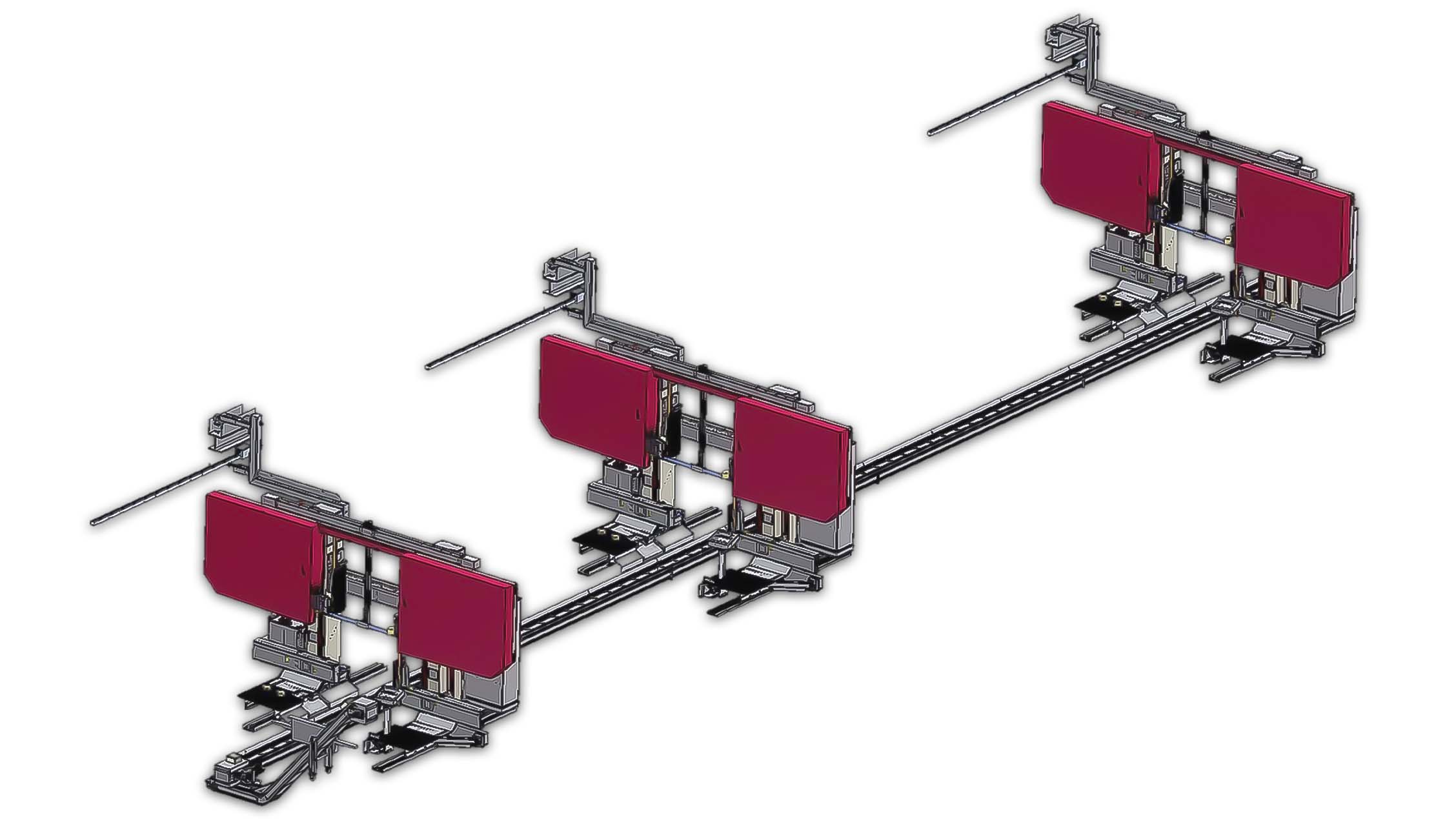
The three robust sawing units move independently of each other via a rail system. Sawing several jobs in parallel not only saves costs and time, but also reduces the load on the crane, thereby ensuring the safety of the employees.
Productivity increases and non-productive times are significantly reduced, as loading and unloading only takes place once during the main shift. Process reliability in three-shift operation is absolutely guaranteed, as the sawing machines are extremely robust and hardly susceptible to faults.
Depending on the machine selected, materials with a cutting range of up to 2,100 x 1,100 millimetres can be sawn. The giant band saws are therefore perfect for the economical cutting of bulky materials such as metal blocks, heavy cast products or solid forged products.


Horizontal bandsaw Font size test
The automatic bandsaw offers powerful, accurate cuts with low costs per cut
The automatic band saw Font size test from BEHRINGER is designed for economical use in industry and the steel trade. It offers high-performance saw cuts with simultaneously low cutting deviations in easy to difficult-to-machine metals and plastics. In doing so, the band saw covers a wide range of materials from profiles and tubes to solid material. Thanks to its wide-opening full enclosure, the automatic band saw Font size test offers uncompromising work protection combined with good accessibility. Its low energy consumption contributes to resource-saving production.
-

Automatic band saw Font size test
-

Servo-downfeed with cutting pressure control
-

Intuitive BehrCtrl10 touch control
-

Product video horizontal bandsaw Font size test
-

Stable cast iron saw frame
-

Electrically driven chip brush
-

Line laser (option)
-

Bundle clamping device (option)


- Sensitive Behringer cutting pressure control
increases the cutting performance when sawing tubes and profiles, as it automatically adapts the saw feed of the machine to the changing material cross-sections. Due to the arrangement directly at the back of the blade, the system regulates quickly and precisely.
| Feeding length single stroke | 650 mm |
| Drive power | 2.6 kW |
| Blade speed | 15 - 110 m/min |
| Saw blade dimensions | 4,440 x 34 x 1.1 mm |
| Rest piece length in automatic operation | 70 mm |
| Total power | 3.7 kW |
| Saw feed | servo-feed via ball screw |
| Material feed | ball screw |
| Material clamping | hydraulic |
| Saw blade cleaning | electrically driven chip brush |
Fit in terms of education
Qualified training is the foundation for a successful career. This is written in capital letters at Behringer. Our training quota of almost 10% is remarkable.
As we aim to secure our personnel needs in the long term, the training spectrum is extensive and the chance of being taken on after the training is excellent. We convey the training content in a practice-oriented approach and place great value on teamwork.

Electronics technician (m/f/d) specialising in industrial engineering
Electronics technicians for industrial engineering are used for the electrical installation of our sawing machines as well as within our control cabinet construction and sometimes accompany the commissioning of our products.

Main focus of the education:
- Pass through all departments in mechanical engineering, e.g. technical office, logistics, quality assurance, electrical assembly
- Getting to know our products - from the design to the finished sawing machine
- Learning and carrying out the assembly, installation up to the commissioning of sawing machines and systems
- Construction and wiring of control cabinets according to circuit diagrams
- Troubleshooting and fault rectification with the aid of circuit diagrams
Your profile:
- Mathematics, physics and logical thinking are no problem for you
- The construction of complex electronic circuits inspires you
- Good secondary modern school diploma
- Ability to work in a team, careful working method, self-reliance
We offer:
- High take-over rate
- Convenient working hours (35h week)
- Training and further education opportunities
- Regular inter-departmental trainee projects
- Modern working environment using the latest technologies
- Practice-oriented induction by training supervisors
- Collegial working atmosphere with flat hierarchies
Duration of the education:
- Duration: 3.5 years
Further education opportunities:
- Technician qualification
- Master craftsperson training
Foundry mechanic (m/f/d)
Foundry mechanics produce castings in single pieces or small series with the help of models. In our state-of-the-art iron foundry, training is a top priority.

Main focus of the education:
- Passing through all departments in the foundry and our mechanical production
- Getting to know our products - from planning to the finished cast part
- Learning the essential skills of the profession:
- (1) Preparation of various moulding materials
- (2) Making sand cores
- (3) Provide and prepare models
- (4) Charge melting furnaces and analyse the molten metal structures
- (5) Mould and lay out models
- (6) Check the quality of the castings
Your profile:
- You have mechanical skills and a good sense of spatial awareness
- You have a basic level of physical fitness
- Logical thinking does not cause you any problems
- You have a good secondary school leaving certificate
- Careful and independent way of working, ability to work in a team
We offer:
- High take-over rate
- Convenient working hours (35h week)
- Training and further education opportunities
- Modern working environment using the latest technologies
- Practice-oriented induction by training supervisors
- Collegial working atmosphere with flat hierarchies
Duration and course of education:
- Duration: 3.5 years
- Passing through all departments in the foundry and our mechanical production
- Vocational school as block instruction at the WMS Stuttgart - Bad Cannstatt, including accommodation in the boarding school / dormitory there.
Further education opportunities:
- Foundry technician
- Master craftsperson training
Industrial clerks (m/f/d)
Industrial clerks are involved in all commercial processes within the company. Areas of application are procurement, work preparation, sales, financial accounting, human resources and service.

Main focus of the education:
- Pass through all commercial departments, e.g. purchasing, sales, accounting, customer service, work preparation, reception
- Getting to know the products of all departments, also in the production area
- Processing of commercial tasks (e.g. preparation of offers and invoices, placing orders) with the help of the latest IT programmes such as MS Office, SAP R/3 and Outlook
Your profile:
- Interest in commercial processes of an industrial company
- Ability to think logically and in an integral way
- Organisational and communication skills
- Secondary modern school diploma or (technical) high school graduation
- Good knowledge of German and English language
We offer:
- High take-over rate
- Convenient working hours (35h week)
- Training and further education opportunities
- Regular inter-departmental trainee projects
- Modern working environment using the latest technologies
- Practice-oriented induction by training supervisors
- Collegial working atmosphere with flat hierarchies
Duration of the education:
- Duration: 3 years
Further education opportunities:
- Bachelor professional
- Master professional
Industrial mechanic (m/f/d) in the field of machine/system technology
Our industrial mechanics receive profound, practice-oriented occupational training in our company. They mainly carry out the assembly of subassemblies or sawing machines and systems.

Main focus of the education:
- Training department: Machine assembly
- Pass through various specialist departments such as parts production, work preparation, system engineering, technical office, BTZ technology centre, foundry and warehouse
- Getting to know our products - from the design to the finished sawing machine
- Assembly of subassemblies and machines: from pre-assembly units to special machines
Your profile:
- Craftsmanship and technical understanding
- Interest in manual and machine work
- Very good secondary school leaving certificate or secondary modern school leaving certificate
- Ability to work in a team and enjoy working with mechanics
We offer:
- High take-over rate
- Convenient working hours (35h week)
- Training and further education opportunities
- Regular inter-departmental trainee projects
- Modern working environment using the latest technologies
- Practice-oriented induction by training supervisors
- Collegial working atmosphere with flat hierarchies
Duration of the education:
- Duration: 3.5 years
Further education opportunities:
- Technician qualification
- Master craftsperson training
Mechatronics technician (m/f/d)
Mechatronics technicians combine the occupational profiles of industrial mechanics and electronics technicians and thus find their way in both worlds. The tasks after apprenticeship range from assembly and commissioning in-house to service assignments at national and international level.

Main focus of the education:
- Pass through all departments in mechanical engineering, e.g. technical office, logistics, quality assurance, electrical assembly
- Getting to know our products - from the design to the finished sawing machine
- Learning and carrying out electrical assembly, installation through to commissioning of saws and saw systems
- Learning and carrying out the mechanical assembly of subassemblies up to the acceptance of the sawing machine
- Assembly and wiring of control cabinets according to circuit diagrams
- Installation of pneumatic and hydraulic systems
Your profile:
- Craftsmanship and enthusiasm
- You are enthusiastic about the construction of complex electronic & mechanical systems
- Mathematics, physics and logical thinking are no problem for you
- Good secondary modern school certificate
- Ability to work in a team, careful working method, self-reliance
We offer:
- High take-over rate
- Convenient working hours (35h week)
- Training and further education opportunities
- Regular inter-departmental trainee projects
- Modern working environment using the latest technologies
- Practice-oriented induction by training supervisors
- Collegial working atmosphere with flat hierarchies
Duration of the education:
- Duration: 3.5 years
Further education opportunities:
- Technician qualification
- Master craftsperson training
Technical product designer (m/f/d) in the field of machine/system design
Technical product designers are significantly involved in the development of new products as well as the implementation of customer requirements / special design. They create components and assemblies for our sawing machines and systems in cooperation with our engineers and technicians and accompany the corresponding manufacturing and assembly process.

Main focus of the education:
- Creating design drawings and technical sketches
- Creation of 3D construction models (Autodesk Inventor)
- Preparation of supporting documents (drawings, parts lists, production and assembly documents, documentation)
- Getting to know the operational processes through intensive inter-departmental training blocks
- Collaboration in ongoing projects as an integral part of the team
Your profile:
- Technical interest and understanding
- Good spatial imagination
- Ability to work in a team and good communication skills
- Secondary modern school diploma or (technical) high school graduation
- Good knowledge of mathematics and technology
We offer:
- High take-over rate
- Convenient working hours (35h week)
- Training and further education opportunities
- Regular inter-departmental trainee projects
- Modern working environment using the latest technologies
- Practice-oriented induction by training supervisors
- Collegial working atmosphere with flat hierarchies
Duration of the education:
- Duration: 3.5 years
Further education opportunities:
- Mechanical engineering technician
- Technical business economist
Machinist (m/f/d)
Machinists are employed within our mechanical engineering department in assembly and machining. Generally 3 apprenticeship places are available per year.

Main focus of the education:
- Pass through all departments in mechanical engineering, e.g. technical office, logistics, quality assurance, electrical assembly
- Getting to know our products - from the design to the finished sawing machine
- Manufacturing of components and assemblies
- Programming and monitoring of machine tools
- Monitoring and planning of the production processes
Your profile:
- Mathematics and logical thinking are no problem for you
- Pleasure in working with machines
- Very good secondary school leaving certificate or secondary modern school leaving certificate
- Ability to work in a team, careful working method, self-reliance
We offer:
- High take-over rate
- Convenient working hours (35h week)
- Training and further education opportunities
- Regular inter-departmental trainee projects
- Modern working environment using the latest technologies
- Practice-oriented induction by training supervisors
- Collegial working atmosphere with flat hierarchies
Duration and course of education:
- Duration: 3.5 years
- 6 school days per month
- Inter-company trainings of 1-week duration via the Chamber of Crafts to deepen the training content
Further education opportunities:
- Technician qualification
- Master craftsperson training
Automatic Plate Saw LPS-TA
The LPS-TA is the ideal solution from BEHRINGER when it comes to fully…
Stahlbau Westerwald relies on a MAGevo 620
The plate processing centre from Vernet Behringer has been supporting the…
Open Days at Behringer France
To celebrate its 25th anniversary, BEHRINGER FRANCE is organising two open…
Making room for something new
Millimetre work was required when several machining centres were placed on…
History of the iron foundry in Kirchardt
From molten iron to the finished product
The production of cast iron is deeply rooted in BEHRINGER's corporate philosophy. As early as 1951, the first foundry was put into operation under simple working conditions in the centre of Kirchardt (Baden-Württemberg). Over time, the portfolio was expanded to include the manufacture of cast products for external customers.

The first foundry
With the first foundry in the centre of Kirchardt below the Protestant church, August Behringer's dream ‘from molten iron to the finished product’ came true. It all began with a cupola furnace, wooden boxes nailed together and a lot of inexperience. To acquire the necessary expertise, the company made contact with a friend.

Expansion in the village
The foundry moved to a neighbouring property in Kirchardt. A second oven as well as conveyor belts and roller conveyors were installed so that production could be more efficient. At this time, the company mainly produced castings for its own saw production.

Move to the industrial area
With the start of construction in today's industrial area, the foundry is fundamentally modernised. The first casting was started in June 1971. With a new electric furnace, spheroidal graphite cast iron could now be produced in addition to grey cast iron. At the same time, working conditions improved.
As the mechanical engineering remained in the village, the finished castings had to be transported by lorry to the old factory for processing and assembly.

A second melting oven
In order to fulfil the high demand, the mechanical engineering and foundry departments were each extended by one hall. The foundry was given a second melting furnace and a modern dedusting system.

Installation of a moulding line
In order to be able to continue producing economically, the decision was made to invest in a fully automatic moulding line. Technical progress in the foundry was ensured by a new, fully automatic sand preparation plant (1985).

New construction of the foundry
The investment in state-of-the-art production technology combined with many years of expertise in grey and spheroidal graphite cast iron has positioned BEHRINGER in the premium class of German and European foundries.

Installation of a PV system
With the installation of a photovoltaic system on the roofs of the foundry and the model making hall, we can now cover part of our energy requirements ourselves.
